

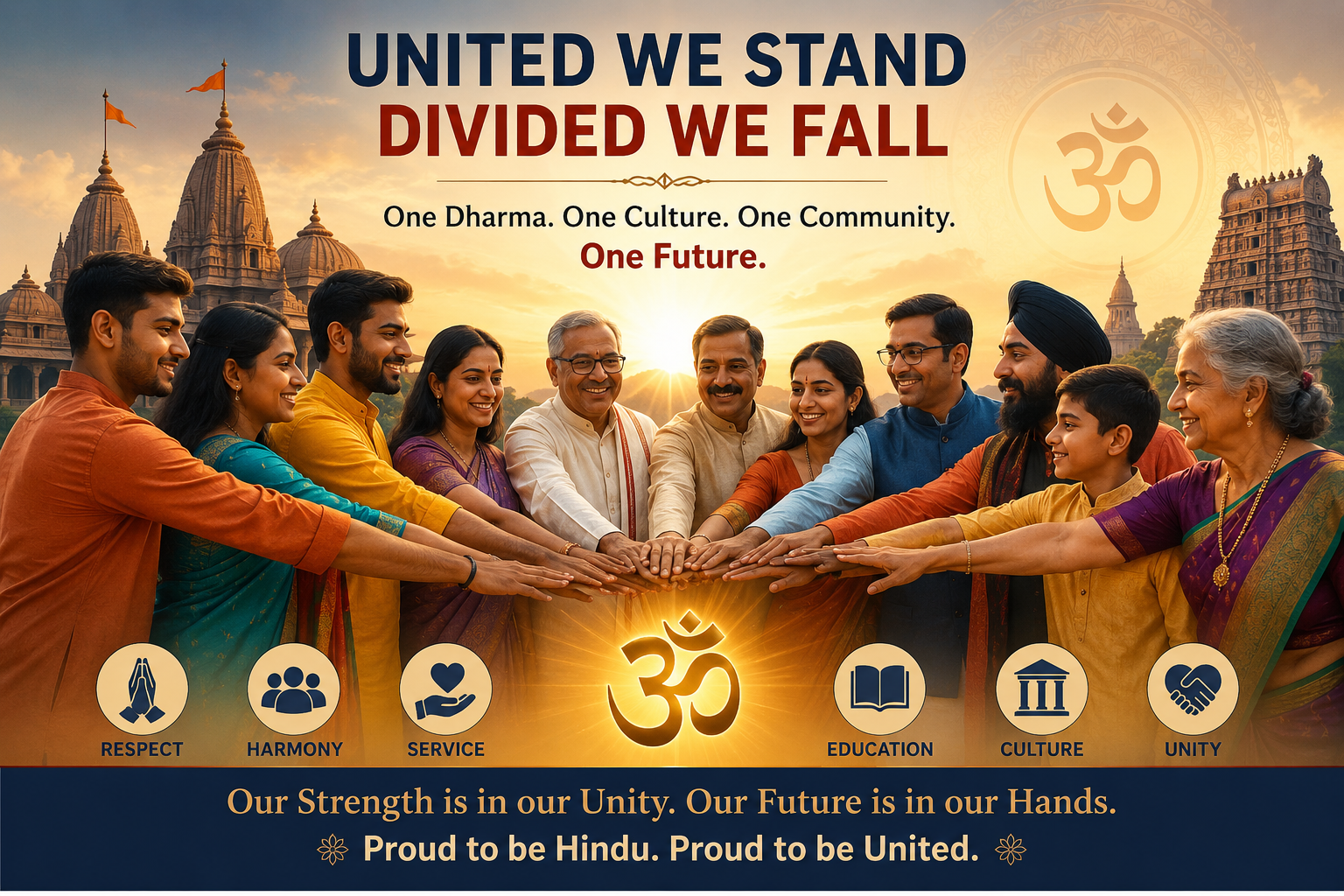
Unity is not about uniformity. It is about standing together with confidence, dignity and a shared commitment to our values, culture and future.
The Hindu community in Britain has come a long way. From the early generations who arrived with little more than determination and hope, Hindus have built families, businesses, temples, cultural organisations and successful professional careers. Today, British Hindus make an important contribution to the social, economic and cultural life of the United Kingdom.
Yet, at a time when our community is growing in confidence and influence, we must ask ourselves an important question: Are we sufficiently united?
The answer should concern us all.
Unity Does Not Mean Everyone Must Think Alike
Hindu society has always been diverse. We come from different regions of India and other parts of the world. We speak different languages, follow different traditions and worship in different ways.
This diversity is not a weakness. It is one of the great strengths of Hindu civilisation.
Hinduism has historically accommodated different paths of worship, philosophies and traditions. Therefore, unity does not require us to abandon our differences. Instead, it requires us to recognise what we share.
Our common heritage, our values, our families, our culture, our festivals and our commitment to passing these traditions to future generations can provide the foundation for unity.
We can be different in our traditions while remaining united in our purpose.
Why Unity Matters Today
A community that is organised and united is better able to represent itself.
When Hindu organisations, temples, community groups, professionals, young people and families work separately, their efforts can become fragmented. Valuable resources, ideas and talents may remain isolated.
But when we work together, our collective contribution becomes much greater.
Unity can help us:
- Give the Hindu community a stronger and more constructive voice.
- Encourage greater participation in civic and democratic life.
- Preserve Hindu culture, languages, traditions and heritage.
- Support Hindu families and young people.
- Strengthen cooperation between temples and community organisations.
- Encourage charitable and humanitarian activities.
- Promote better understanding of Hinduism within wider British society.
- Develop future community leaders.
This is not about seeking privilege or special treatment. It is about ensuring that British Hindus participate confidently and constructively in the society of which we are an integral part.
Our Temples Can Become Community Hubs
Hindu temples have an important role beyond religious worship.
They can become centres of education, culture, service and community engagement. They can provide opportunities for children to learn about Hindu philosophy, Sanskrit, Indian languages, music, dance and traditions.
They can also bring different generations together.
Our temples and organisations should encourage collaboration rather than competition. There is room for every tradition and every institution.
Instead of asking, “Which organisation do you belong to?”, perhaps we should increasingly ask, “What can we do together for the benefit of our community?”
That change in attitude could make a remarkable difference.
The Next Generation Must Be at the Centre
If Hindu society is to remain strong in Britain, young people must not simply be spectators. They must become participants and future leaders.
Many young British Hindus are highly educated, professionally successful and comfortable in both British and Indian cultural environments. They have enormous potential.
We need to create platforms where they can contribute their ideas, develop leadership skills and take responsibility.
At the same time, we must understand the challenges they face.
Young Hindus live in a rapidly changing society. They are exposed to many cultures, ideas and influences. Rather than telling them simply to “follow tradition”, we should explain the meaning behind our traditions and give them the confidence to understand and articulate their heritage.
A tradition survives when the next generation understands its value—not merely when it is told to preserve it.
Unity Through Service
One of the most powerful ways to unite society is through seva—selfless service.
Hindu organisations across Britain already undertake charitable work, support the elderly, help families in need and contribute to wider humanitarian causes.
Imagine the impact if these efforts were better coordinated.
Whether it is supporting food banks, helping vulnerable families, responding to disasters, assisting the elderly or contributing to local community projects, service creates bridges.
It also demonstrates an important truth about Hindu values: our faith is not only about worship; it is also about responsibility towards society.
We Must Participate in British Public Life
British Hindus should also be encouraged to participate fully in civic life.
That means voting, engaging with local councils, participating in community initiatives, supporting charitable causes and encouraging capable people to enter public service.
Our community should not remain an observer of British society. We should be active contributors.
Hindus have much to offer Britain—from business and medicine to education, technology, law, public service and the voluntary sector.
The values of family, responsibility, hard work, education, respect for others and service to society can make a positive contribution to Britain’s future.
Let Us Put Differences Aside
Every community has disagreements. Hindu society is no exception.
There will always be differences of opinion about organisations, leadership, methods and priorities. Healthy debate is necessary.
But disagreements should not become permanent divisions.
We should learn to distinguish between differences that enrich our community and divisions that weaken it.
No individual, organisation or institution is bigger than the community itself.
Leadership should therefore be based on cooperation, humility and service—not personal ambition.
A Common Vision for the Future
Perhaps what we need most is a shared vision.
A vision in which every Hindu child in Britain can learn about their heritage with pride.
A vision in which our temples and organisations cooperate with one another.
A vision in which our young people are encouraged to become leaders.
A vision in which Hindu women play an equal and prominent role in community life.
A vision in which British Hindus participate confidently in public life.
A vision in which our diversity is celebrated rather than allowed to divide us.
And, above all, a vision in which we recognise that our collective strength is far greater than our individual efforts.
The Time for Unity Is Now
The future of Hindu society in Britain will not be determined only by numbers. It will be determined by our organisation, our confidence, our values and our willingness to work together.
We should not wait for a crisis before discovering the importance of unity.
Let us build unity during peaceful and prosperous times. Let us build relationships between organisations. Let us encourage dialogue. Let us involve young people. Let us support our temples. Let us recognise the contributions of women and senior citizens. Let us celebrate our diversity while strengthening our common identity.
The message is simple:
Different traditions, one heritage.
Different organisations, one community.
Different voices, one shared future.
British Hindus have every reason to look to the future with confidence.
But that future will be stronger if we walk towards it together
By :Surinder Gautama

Readers like you, make ESHADOOT work possible. We need your support to deliver quality and positive news about India and Indian diaspora - and to keep it open for everyone. Your support is essential to continue our efforts. Every contribution, however big or small, is so valuable for our future.





I totally agree with Mr Gautama’s comments. The colonisers did a good job in fragmenting us by siding a so called more powerful class for their own leaving us with a mindset of post independence inferiority complex to think where we belong rather than who we are. This gave opportunity to the left wing political parties to raise a false flag in the favour of the less well to do based upon caste system but after 70 years the Congress party were not able to improve their lot anyway. Hence in the UK context we definitely need to be visible whether politically or in media. Anything watched or said against our belief should be properly contested by partaking in radio discussion, letters to BBC and media outlets. We must think alike and together otherwise any ruling party won’t hear our woes