There are public figures whose contribution is measured by the offices they have held, and there are others whose true impact is reflected in the lives, institutions and social causes they have touched. Dr Avinash Rai Khanna belongs firmly to the latter category. Parliamentarian, social reformer, humanitarian and author, his journey presents a distinctive combination of public leadership and grassroots social concern.
His work has extended across politics, humanitarian service, education, social awareness and writing. He served in both the Lok Sabha and Rajya Sabha, while his association with the Indian Red Cross Society, including as Vice Chairman, further reflects the humanitarian dimension of his public life. His contribution was academically recognised when The ICFAI University, Sikkim conferred upon him the Doctor of Literature (D.Litt.), Honoris Causa. The university itself lists Avinash Rai Khanna among the distinguished personalities on whom it conferred honorary doctorate degrees.
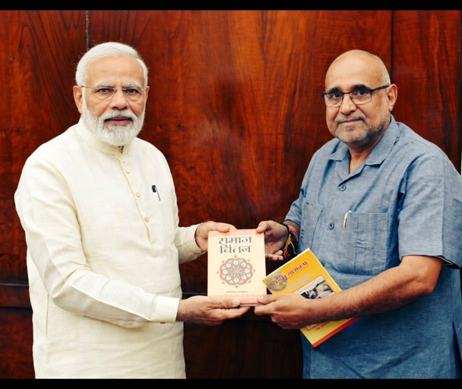
The book focusing on social thinking, societal problems and community welfare. What distinguishes the book is that it does not approach society merely as something to be observed or criticised. Its underlying philosophy is one of collective responsibility and practical action.
That principle runs throughout Samaj Chintan. The book turns attention towards people who are too easily overlooked slum dwellers, homeless people, orphans and the destitute. It also addresses the serious challenge of drug addiction among young people, looking towards de-addiction and rehabilitation rather than simply condemning those affected.
This is what gives the book its human character. Samaj Chintan is not simply an intellectual exercise in analysing what is wrong. It repeatedly asks what ordinary citizens, communities and institutions can actually do about it.
Independent descriptions of the book similarly highlight Dr Khanna’s practical discussion of responsibilities towards orphaned and missing children, education, health and everyday social problems. Significantly, the work is overwhelmingly centred on social issues rather than party politics, despite being written by someone deeply involved in political life.
Samaj Chintan advocates teaching young people about fundamental rights as well as social duties through school and college curricula. This is an important distinction: education, in his thinking, should not merely prepare someone for employment; it should help create a responsible citizen.
His philosophy therefore connects rights with responsibility, individual advancement with social duty, and education with nation-building.
When the Punjabi version of Samaj Chintan was launched, the book was described as being focused on strengthening the basic fabric of society. Dr Khanna explained that its ideas grew from his own life experiences and emphasised that social transformation is a responsibility shared by everyone.
His social contribution has continued to attract recognition. The World Book of Records London appreciation presented in February 2026, shown in the accompanying material, acknowledges contributions spanning governance, human rights, social reform and public service.
Yet perhaps the more meaningful measure of Dr Khanna’s work lies beyond certificates and positions. It lies in the consistency of one idea across his public service and writing: leadership carries an obligation towards those whose voices are least likely to be heard.
That is ultimately what makes Samaj Chintan an appropriate reflection of Dr Avinash Rai Khanna himself.
It speaks about vulnerable people without treating them merely as statistics. It discusses youth problems while searching for rehabilitation. It connects education with civic responsibility. And above all, it refuses to place the entire responsibility for social change upon governments alone.
In an age when public debate can easily become an exercise in identifying who is to blame, Samaj Chintan asks the more constructive question:
That question captures much of Dr Avinash Rai Khanna’s public personality: a former parliamentarian who continued to think beyond Parliament, a humanitarian whose concerns extend to society’s vulnerable sections, and an author who attempts to turn observation into action.
Dr Khanna’s journey demonstrates that public service is not defined merely by holding office. Its greater test is whether one’s experience, influence and ideas are ultimately placed at the service of society.
“From Parliament to humanitarian service, and from experience to the pages of Samaj Chintan, Dr Avinash Rai Khanna’s message remains consistent: a stronger nation begins when society stops waiting for change—and starts becoming the change.”
By Prince Lumb

Readers like you, make ESHADOOT work possible. We need your support to deliver quality and positive news about India and Indian diaspora - and to keep it open for everyone. Your support is essential to continue our efforts. Every contribution, however big or small, is so valuable for our future.