

Kanta Adhin-Knight with a mission for justice, history, and connectio
By :Dr. Chan E.S. Choenni
[24 april 2026 -Nethelands
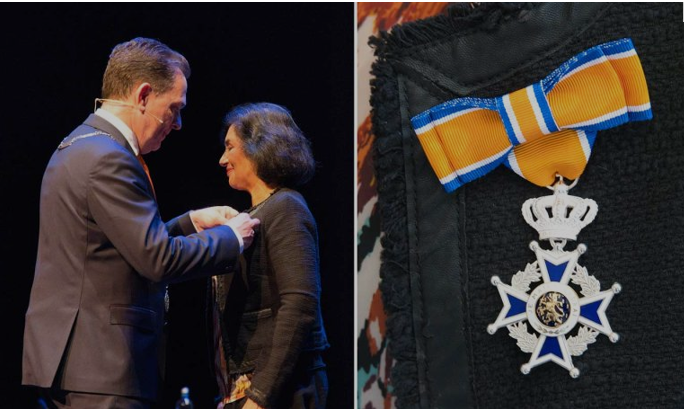
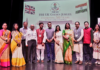
 Mayor Michel Bezuijen pins the royal decoration on Kanta Adhin at the Stadstheater in Zoetermeer. It is 24 April 2026, the annual “lintjesregen” (Royal Honours Day). A moment when many people are honored, yet still deeply personal for each individual. Ms. Drs. Kanta Shilavati Adhin is appointed Knight in the Order of Orange-Nassau—an honor awarded to those who have dedicated themselves to society over a long period in an exceptional way. Anyone who knows her understands: this recognition is well deserved.

From Paramaribo to Leiden
Kanta is born on 15 April 1956 in the district of Nickerie in Suriname but grows up largely in Paramaribo. In her environment, education and social engagement are taken for granted. After completing Gymnasium B, she leaves for the Netherlands in 1974 to study law at Leiden University.
She chooses International Law. “I was always interested in how countries interact,” she later says. “For me, law has never been just a system of rules, but a way to organize justice.”
She graduates in 1978 and returns to Suriname. From 1979 to 1983, she works at the Ministry of Foreign Affairs in Paramaribo, in the departments of Legal Affairs and Treaties. When she settles again in the Netherlands in 1983, she decides to study Dutch law as well, again in Leiden. This dual legal foundation—international and national—becomes the common thread throughout her career.

A career in service of the rule of law
From 1986 until her retirement in 2022, Adhin works at the Ministry of Foreign Affairs in The Hague. Over more than 35 years, she holds various positions, from the Treaties Department to the Human Rights Department and the United Nations Department.
Colleagues praise her analytical sharpness and careful wording. “Kanta was someone who always sought nuance,” a former colleague recalls. “She looked beyond the political issues of the day.”
Between 2007 and 2011, she works at the Dutch Embassy in Dublin, where she serves as Acting Ambassador during 2007–2008. This is a period in which Ireland holds a crucial referendum on the future of Europe, with all European eyes focused on Dublin. Later, from 2011 to 2015, she works at the Permanent Representation of the Netherlands to the Council of Europe in Strasbourg as Deputy Permanent Representative.
In the final phase of her career, she is affiliated with the Legal Affairs Department. There, she serves, among other roles, as Agent for the Kingdom of the Netherlands before the European Court of Human Rights. She represents the Netherlands in sensitive human rights cases and advises on matters concerning the International Criminal Court and migration. “The core of my work was always: how do we ensure that international agreements truly have meaning for people?” says Adhin. “Human rights are not an abstract concept—they concern real lives.”

Voice and bridge-builder in the community
Alongside her professional career, Adhin builds an impressive portfolio of voluntary work. Since 1986, she has contributed through lectures and publications to debates on integration, identity, and citizenship.
As secretary of the World Hindu Federation Netherlands (1986–1998), she plays a key role in organizing the International Hindu Conference in The Hague in 1988—the first in the Netherlands. She is responsible for various publications on themes such as political tolerance, healthcare, and social engagement from a Hindu perspective. In the 1990s, she serves on the boards of the welfare organization Un Doro and the Organization Hindu Media. However, the broader public comes to know her mainly as editor-in-chief of the magazine Hindorama (1998 – 2004), which grows into a leading publication within the Hindustani community.
Following the publication of Paul Scheffer’s essay The Multicultural Drama and the attacks of 11 September 2001, the societal debate shifts, and multiculturalism comes under pressure. Adhin actively engages in this discussion. “Full participation in society and maintaining your own culture are not mutually exclusive. But it requires responsibility from both sides.” She emphasizes that cultural expression is also a human right, while warning against dependence on subsidies. “Communities must take initiative and responsibility for preserving their culture.”

The Jnan Adhin Institute: knowledge as a foundation
Since 2004, Adhin has been chair of the Jnan Adhin Institute (JAI), a foundation named after her father and dedicated to sharing knowledge about Surinamese culture and history, particularly that of Surinamese Hindustanis. Under her leadership, books are published, lectures are organized, and projects on colonial history are initiated. The institute advocates an inclusive approach: not only the history of slavery, but the history of all Surinamese population groups deserves attention.

Together with the author of this piece, she has written several books, including From British-Indian Migrants via Suriname to Citizens of the Netherlands (2003) and the recent 150 Years of Hindustanis 1873–2023 – A History of Two Migrations (2024). “History gives people roots,” says Adhin. “And those who know where they come from can stand more firmly in the present.”
Her commitment to historiography and community-building is also evident in her journalistic work. From 1998 to 2004, she serves as editor-in-chief of Hindorama, publishing articles on Hindustani and Surinamese history, culture, and integration. The magazine becomes a leading and high-quality publication within the community. A special issue appears in 1998 marking 125 years of Hindustanis in Suriname and 25 years in the Netherlands. From 2000 to 2004, Hindorama becomes a bi-monthly magazine with a broad and engaged readership.
Additionally, from 2017 to 2023, she is a board member of Writers Unlimited in The Hague, an organization promoting international literature and freedom of expression. Since 2019, she has been editor-in-chief and columnist of Hindorama.com, a platform supported in part by JAI that grows into an authoritative website within the broader Surinamese community. In this role, she continues the tradition of the original magazine in digital form, reaching a new generation of readers.
After her retirement, she becomes active as a language volunteer at the Zoetermeer Library, helping newcomers improve their Dutch. “Language is the key to participation.”

On behalf of the Satya Dharma Foundation, Mr. Ram Rambaratsingh is present to accompany the recipient.
The meaning of the honor
The nomination for the royal decoration is submitted by the Satya Dharma Foundation, which is committed to recognizing individuals who have contributed to the Surinamese community in the Netherlands and to strengthening ties between Suriname and the Netherlands. The nomination highlights her long-standing dedication in both social and administrative fields, her contributions to human rights, and her role in promoting knowledge and dialogue.
Adhin sees the distinction primarily as recognition of collective effort. “You never do this alone,” she says. “I have always worked together with committed and passionate people.”
In his speech, Mayor Bezuijen remarks: “She prefers to do her work quietly and modestly, but her voice is heard—and that matters. By making her voice heard, Mrs. Adhin contributes to an open dialogue about a society in which everyone can be themselves.” He also emphasizes that through her work, she has contributed for many years to strengthening tolerance toward other cultures.

In Zoetermeer, two persons of Surinamese origin receive honors. Barryl Biekman, previously knighted, is appointed Officer in the Order of Orange-Nassau for her enduring commitment to combating racism and discrimination.
A Personal Portrait
Anyone who speaks with Kanta Adhin does not encounter a loud activist, but rather a thoughtful, precise woman with a calm demeanor and a genuine interest in others. Her strength lies in her reasoning, in the careful weighing of words. Together with her life partner, Radjin Thakoerdin, she has worked selflessly for many years on Hindorama. At home, articles are discussed, headlines sharpened, and debates held. “We can strongly disagree,” she says with a smile, “but always with respect for each other’s arguments.” Characteristic is her combination of intellectual depth and practical engagement. Whether it concerns an international human rights treaty or a Dutch conversation in the library, the central question is always how people can participate fully in society.
With her appointment as Knight in the Order of Orange-Nassau, a long career dedicated to justice, dialogue, and community receives visible recognition. But those who know her suspect that she herself mainly looks ahead. “There is still so much to tell and to understand,” she says. “As long as we are willing to listen to one another, there is always room for connection.”
Photo credit: Gerard van Warmerdam en Hindorama / Sampreshan
Courtsey: HINDORAMA

Readers like you, make ESHADOOT work possible. We need your support to deliver quality and positive news about India and Indian diaspora - and to keep it open for everyone. Your support is essential to continue our efforts. Every contribution, however big or small, is so valuable for our future.







Such a fascinating story! Thanks Eshadoot to bring to us. Such unsung hero’s and heroines are like tonic for the younger generations growing up outside India, especially in UK and Europe where the paradigm has changed due to left leaning politicians who in there insatiable greed to keep themselves in power have taken blatant support of a this mass of voters who follow a religion promoting violence and behave in a cultish ideology not respecting democratic values, engage in rampant conversion of people from other non-Abrahamic peaceful religion